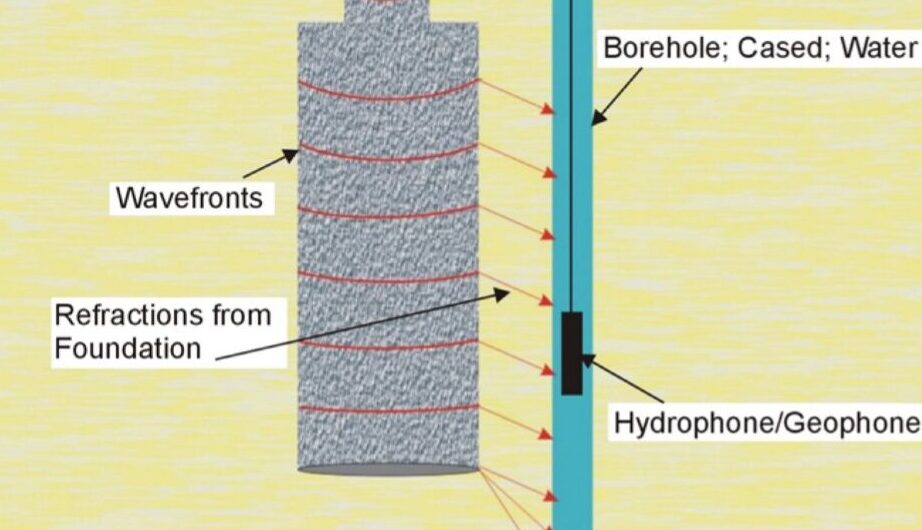
The Parallel Seismic (PS) method is a borehole test method primarily used to determine depths of foundations. However, it can also be used to measure the thickness of the scour zone when it has been filled with mud or soft sand after a flood surge has passed. The field setup for PS tests is shown below.
Data Interpretation
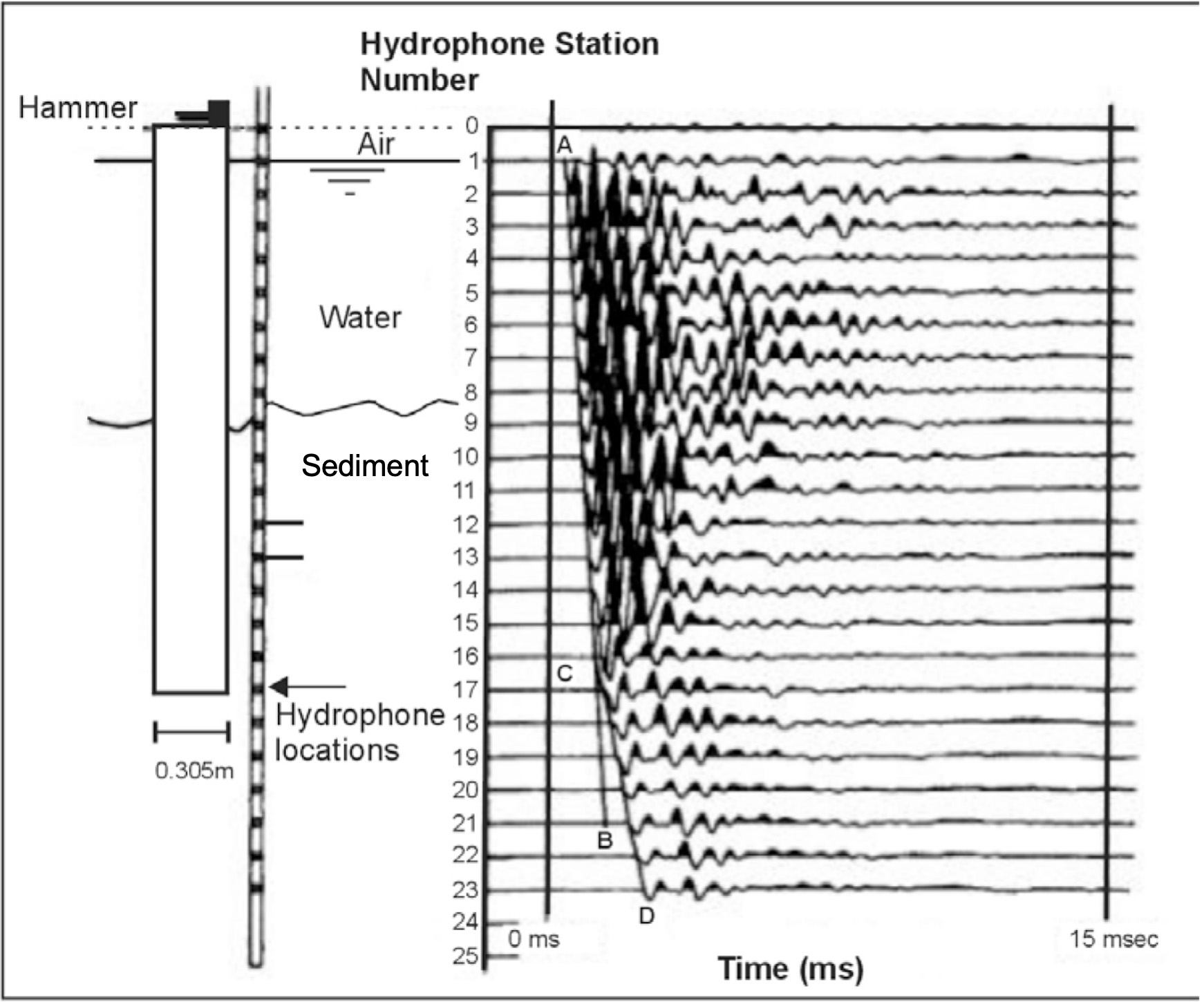
The figure below shows the observed data from a pier test where only stiff competent clay surrounds the foundation, representing no observed scour. The seismic data show strong, continuous energy transmission across this interface, and the first breaks fall along the straight line A-B, corresponding to a refraction velocity of 4,730 m/s, which represents the P-wave velocity in the concrete pier. The first-arrival pattern changes only at the base of the pier. The acoustic characteristics of the sediment are its strong energy attenuation as a function of frequency. The high frequencies are more strongly attenuated than the low frequencies, and much stronger than the attenuation characteristics of either water or competent soil.
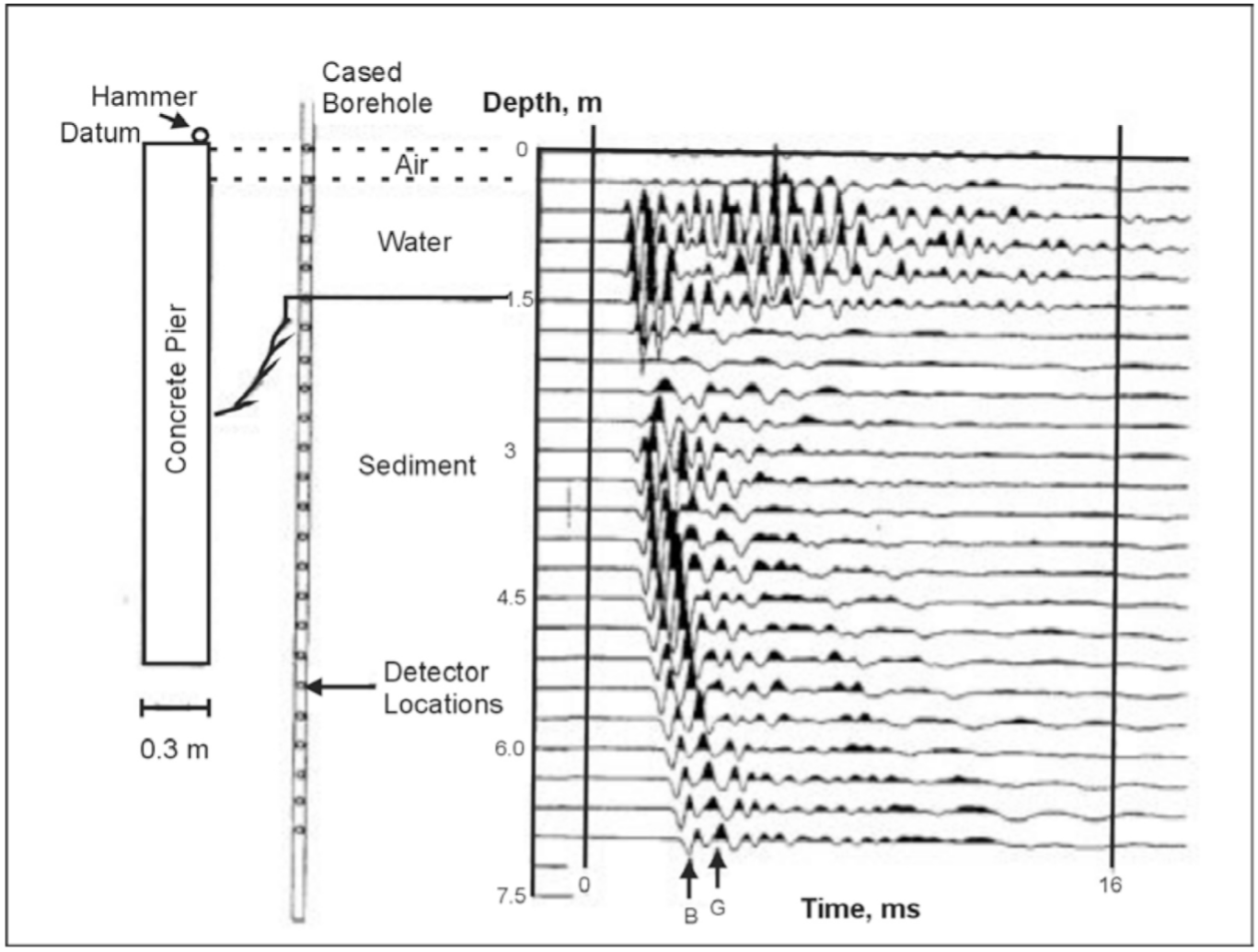
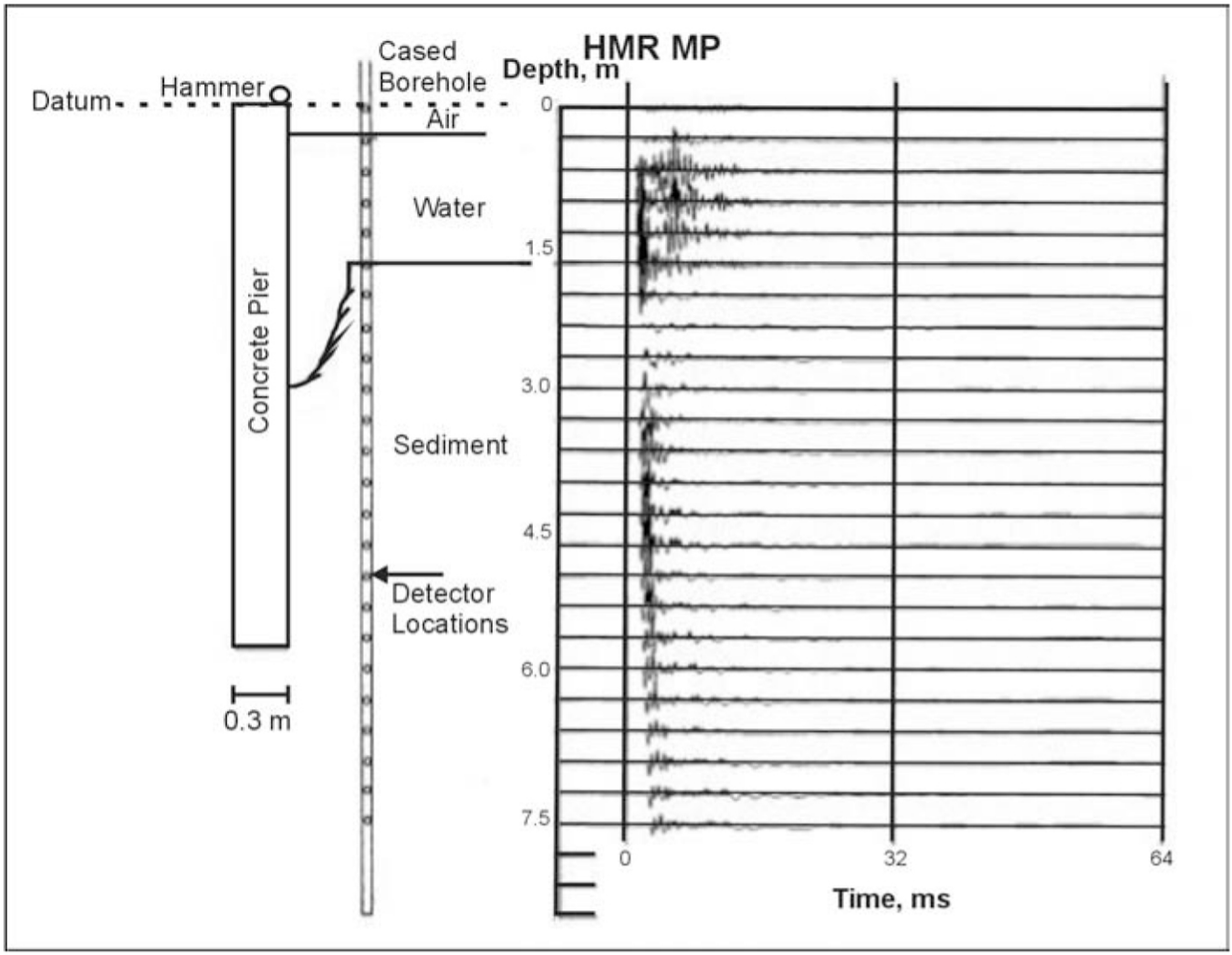
The figure below shows seismic data from a pier test where the scour zone has been partially filled with soft sediment that has slumped in from the sides of the trench. The anomalously low amplitude of the seismic data at recording depths 1.8 through 2.7 m is a consequence of the strong energy-attenuating nature of the mud compared to water above and competent soil below the mud-filled scour hole.
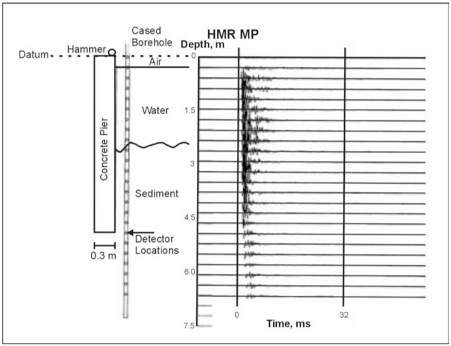
A strong low-cut filter can enhance these high-frequency amplitude variations. Filtered data are shown in the figures below (no-scour case, and scour case). The no-scour case shows uniform data amplitudes across the water-bottom interface, while the scour case shows virtually no high frequency in the mud-filled depth range 1.8 to 2.7 m.
Deliverables
A PS survey report should discuss the findings of the test, primarily focusing on data analysis and interpretation. The report should include interpreted sediment composition including potential scouring backfill, as well as descriptions of test setup, procedures, data acquisition details and data processing schemes.
Advantages
Being a borehole method, the PS method may provide better resolution data than nondestructive surface techniques for determining scour depths.
Limitations
A borehole close to the foundation (within 5 feet) is needed for PS tests, which adds to the cost of the investigation (unless borings are also required for other geotechnical purposes).