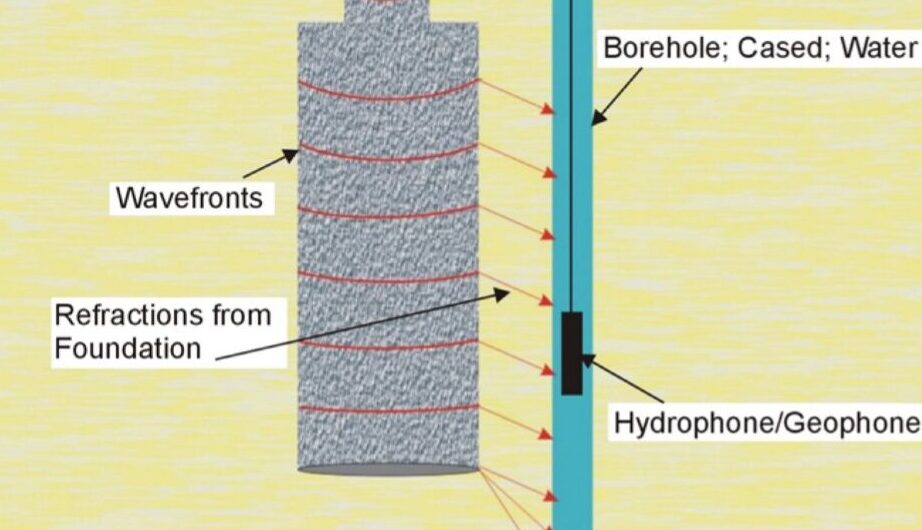
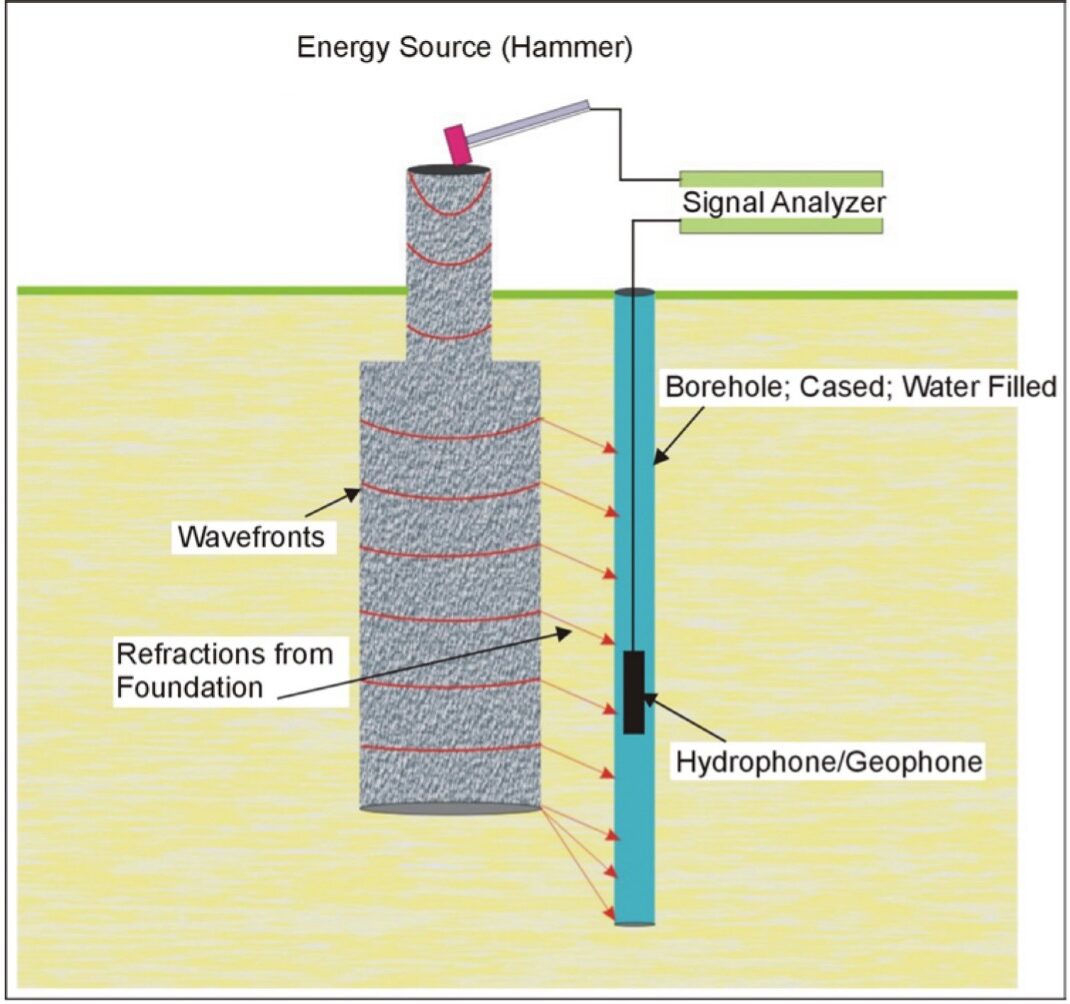
The Parallel Seismic (PS) method is a borehole test method for determining depths of foundations or piles, and to detect major anomalies within a foundation. Foundation depths are normally determined with 95% accuracy or better using this method. Geophones or hydrophones can be used depending on whether the borehole is air-filled or water-filled. The field setup for PS tests is shown below.
Data Interpretation
To interpret parallel seismic data, the time arrival of the first compressional waves is picked from the data for all receiver locations. A plot of the time arrival-versus-depth is prepared, an example of which is illustrated below for evaluation of a drilled shaft. The depth where a change of slope occurs in the first-arrival pattern identifies the foundation depth. Also, the foundation depth can be obtained by observing the depth where the signal amplitude of the first arrival energy is significantly reduced. A break in the graph occurs at a depth of 8.5 m indicating the depth of the base of the shaft.
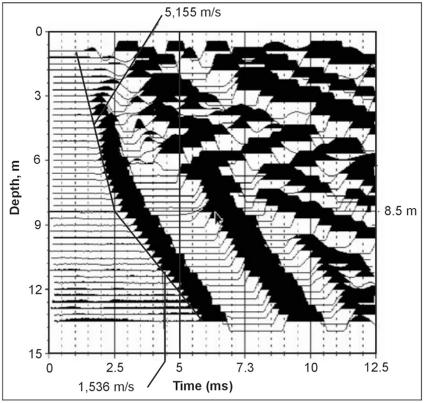
For uniform soil conditions, two trend lines are identified as shown in the figure above. The slope of the upper line is indicative of the velocity of the tested foundation, and the second line is indicative of the velocity of the soil below the bottom of the foundation. The intersection of the two lines gives the depth of the foundation’s base. Breaks and variations in the upper line (foundation velocity) may indicate variations in foundation concrete quality, and possibly foundation integrity issues.
For nonuniform soil conditions, where variable soil velocity conditions exist, the interpretation of data can be difficult due to the nonlinearity of the arrival time of the first compressional waves. In these situations, an alternative interpretation scheme can be used where a V-shaped refraction pattern is searched for in the data. This is because the bottom of the foundation acts as a point diffractor, which produces both upward and downward traveling waves.
Deliverables
A PS survey report should discuss the findings of the test, primarily focusing on data analysis and interpretation. The report should include estimated length and integrity of the tested foundations as well as descriptions of test setup, procedures, data acquisition details and data processing schemes.
Advantages
The PS method is more accurate and more versatile than other nondestructive surface techniques for determining unknown foundation depths. The accuracy of the method depends on the variability of the velocity of the surrounding soil and the spacing between the borehole and the foundation element. Depths are normally determined with 95% accuracy or better.
Limitations
A borehole is needed for PS tests, which adds to the cost of the investigation (unless borings are also required for other geotechnical purposes). Ideally, the borehole should be located within 5 feet of the foundation, which sometimes cannot be achieved. Note that for very uniform soils (such as saturated sands), a successful test can be performed in a hole up to 15 to 20 feet from the foundation. As the borehole moves away from the foundation, interpretation of the PS data becomes more difficult, and the uncertainty in the tip depth determination becomes greater.