
Basic Concept
Thermal Integrity Profiling (TIP) is used to assess the integrity of cast-in-place foundations such as drilled shafts, augered cast-in-place piles, soil nails, anchors, deep soil mixing and jet grout columns. TIP collects temperature data immediately after placement of concrete or grout, which generates heat during the normal hydration and curing process. By collecting temperature data with respect to depth and time, a model of the shaft can be developed and its integrity evaluated. TIP can be used on foundations with diameters up to 14 feet. For smaller elements with diameters less than 24 inches, TIP can be utilized with a single wire affixed to a center reinforcement bars. At diameters greater than 24 inches, a reinforcing cage with multiple wires is the recommended practice.
Limitations
TIP requires data collection leading up to and past peak concrete or grout temperature. Damaged TIP wires and/or malfunctioning equipment in this time frame result in data that cannot be corrected or salvaged. Evaluation of TIP data is also reliant on accurate foundation installation details. These include the volume of concrete placed in the foundation element, drilled diameter, and diameter and length of the reinforcing cage.
Data Acquisition
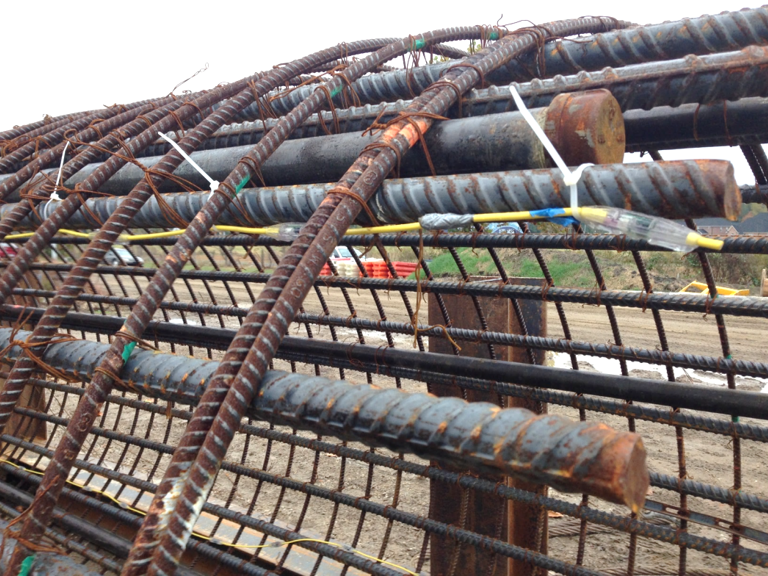
TIP data can be collected with either a probe in pipes cast in grout/concrete or with sacrificial thermal wires. The probe method requires air-filled pipes and attempting to collect at “peak temperature”. The wire method takes passive measurements rather than active measurements with the probe, making timing less important. The thermal wire has a series of digital temperature thermistors mounted every foot along the wire length. With the attachment of a data logger to each wire, the system collects temperature data automatically at a specified time interval (typically 15 minutes).
Data Processing
After data is collected, it is uploaded into the processing software. Measurements such as length of the foundation, diameter of the foundation and cage and distances between wires (if multiple) are entered. A “top of shaft” and “bottom of shaft” correction also need to be completed to offset ambient air and soil temperature influence on the model. Curve matching is used to adjust measured temperatures. The soil temperature is entered for the “bottom” of shaft correction, which is typically the annual average temperature for a geographic location.
Data Interpretation
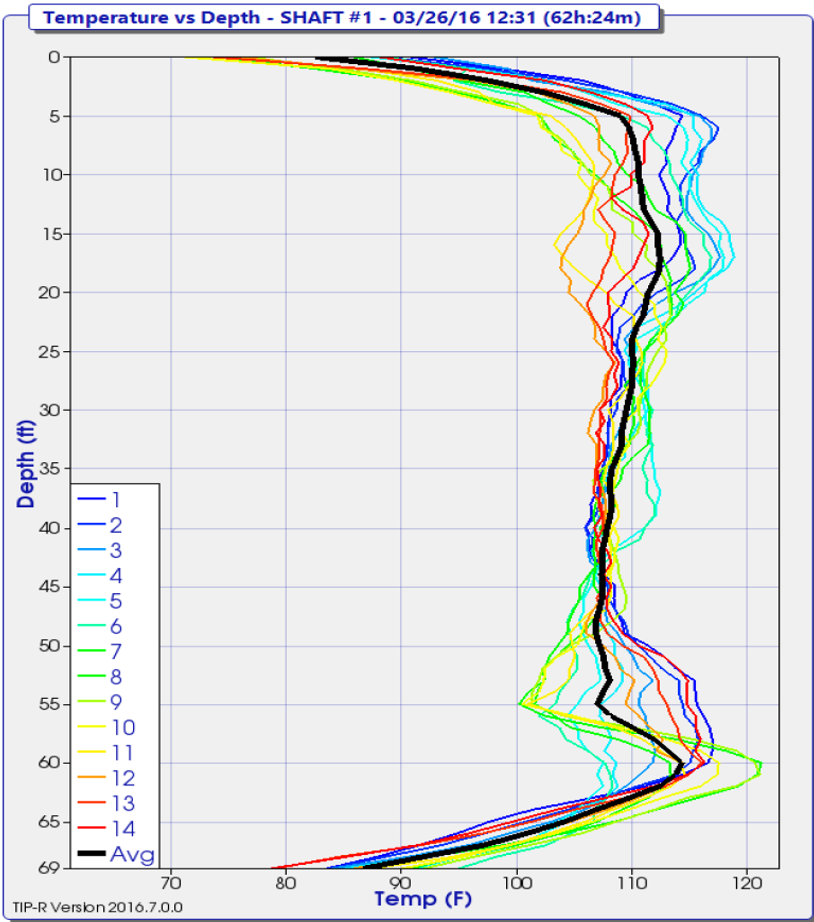
Fluctuations in temperature measurements along the wires or with foundation depth can indicate a condition such as a change in shaft diameter. Temperature fluctuations can also indicate unexpected conditions such as poor centering of the reinforcing cage or the presence of anomalies like over-reaming, soil intrusion, and adulterated concrete. TIP testing measures temperatures within the foundation element during curing, which provides a qualitative analysis of integrity. TIP modeling, in order to provide quantitative results, requires normalization of temperatures at the shaft top, shaft bottom, and where external influences affect temperatures, such as flowing water or lean concrete surrounding permanently cased sections. Additionally, the placed concrete volume observations in the field are critical to TIP modeling. Due to these factors, TIP modeling is subject to the knowledge and experience of those performing analyses.
Applications

Integrity Testing of New Foundations