
Basic Concept
The half-cell potential method is a widely used nondestructive or minimally invasive technique used for assessing the presence of corrosion activity of structural elements and steel pipes. This method is also called the electrochemical potential measurement method, rest potential method, potential mapping, and open circuit potential measurement. It measures the electrical potential difference between a reference electrode (a half-cell) and the metal surface (e.g., steel in reinforced concrete), which is related to corrosion activity. The reference electrode is placed on the surface of the concrete component/structure then connected to a high-impedance voltmeter, which in turn is connected to the embedded metal. The voltmeter measures the potential difference between the metal surface and the reference electrode.
Limitations
Half-cell potential requires good electrical continuity with steel or other metals and therefore may require drilling for electrical contact when steel is unexposed at any location of the test component. However, some recent developments involve the measurement of potential gradients using two reference electrodes, eliminating the need to make direct electrical contact with the rebar.
All metals that are in contact with one another will influence the measurement of half-cell potential, and it is important to understand the electrical connectivity between components when making half-cell potential measurements or take measures to attain electrical isolation for components where measurements are desired. For example, piles in a group may be electrically connected due to contact with reinforcing steel within the reinforced concrete cap.
Half-cell potential is sensitive to moisture, concrete cover, and chloride content. A wet surface, i.e., moisture in concrete, soil or rock is required for ionic conductivity, so that potential can be measured correctly. Advances in concrete and repair technologies, such as dense material overlays, concrete sealers, corrosion inhibitors, chemical admixtures, and cathodic protection systems, must also be considered as they will have an impact on results. Supplementing the results with other nondestructive surveys such as visual, resistivity, or linear polarization methods is recommended.
Measurements and Relevant Physical Properties
Half-cell potential measurements rely on potential differences between concrete, soil or rock and metal reinforcements separated by an environment that may be contaminated by chloride. Chloride, when dissolved in water, creates conditions possible for metal corrosion. The method reads negative voltages which correlate with the level of corrosion activity.
Data Acquisition
The half-cell is generally a hollow tube containing a copper electrode and immersed in copper sulfate solution. Silver/silver chloride reference electrodes are used sometimes in marine environments. The bottom of the tube is porous and is covered in sponge material. The copper sulfate permeates this sponge, which can then be placed on a concrete, soil or rock surface allowing an electrical potential (voltage) to be measured (see figure below). At the beginning of the test, it is prudent to make sure the reference electrode is not old or contaminated, and is calibrated properly, to ensure readings are accurate. For copper sulfate (CSE) electrodes, the most common type, the copper-copper sulfate solution should be replaced monthly or when the solution turns milky, and the copper rod needs to be cleaned to reveal bright copper.
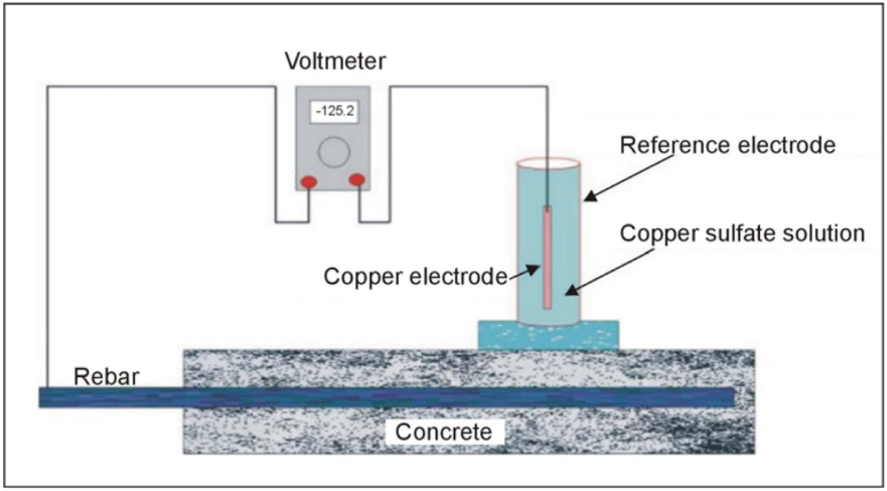
Half-cell surveys require making an electrical connection to the metal being evaluated and then taking readings over the area of interest by pressing the sponge of the reference electrode against the concrete and observing the voltmeter reading. The readings may be taken on a predetermined grid system, or with respect to depth for long linear elements. A device called a potential wheel is sometimes used. This provides a wheel for the tip of the half-cell and allows continuous readout of corrosion potentials, making the method quite rapid. To ensure that sufficient electrolyte is present at the surface, it is usual for all of the reading locations to be pre-wet using a fine spray of weak detergent mixture.
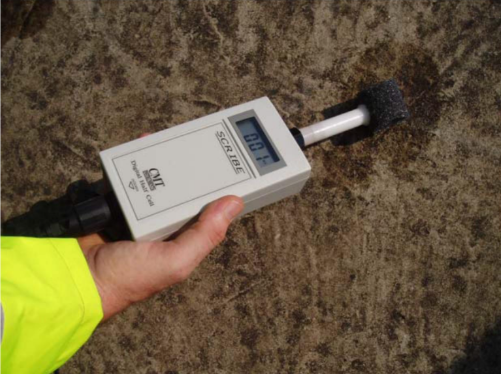
The applicable ASTM method for half-cell potential for evaluating corrosion of rebar is ASTM C876 “The Standard Test Method for Corrosion Potentials of Uncoated Reinforcing Steel in Concrete.”
Data Processing
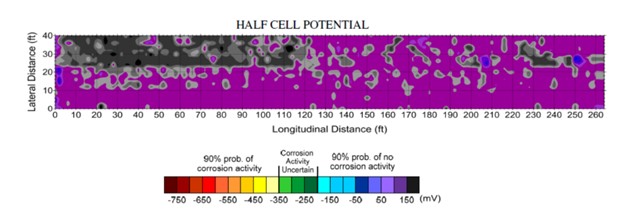
In half-cell potential, voltage is measured directly and hence no specific data processing is required. If the data is stored with corresponding cartesian coordinates, a 2D or 3D contour, or heat map can be generated for ease of interpretation and presentation purposes (see example below).
Data Interpretation
The objective of half-cell surveys is to measure the voltage difference between rebar or other metal, and the concrete or other medium over the metal, and typically this is correlated with corrosion potential. Specific data ranges and correlations vary depending on the type of steel and medium being evaluated. If data are collected and compared periodically, ensure that the measurement conditions (such as concrete wetness) and electrodes used are similar.
Applications

Corrosion Testing (Durability)